


 Find additional Shakespeareances
A Christmas Carol
From the Mouth of Dickens
and His Many Creations
By Charles Dickens, adapted by Greg Oliver Bodine
American Shakespeare Center, Blackfriars Playhouse, Staunton, Va.
Saturday, November 22, 2025, I–8 (Back, stalls)
Directed by Leda Hoffmann
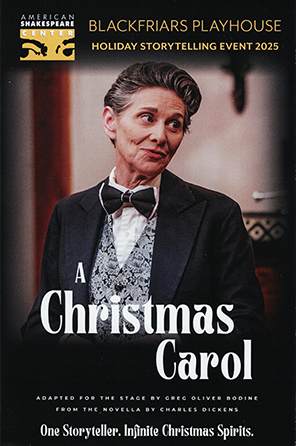
American Shakespeare Center program with Angela Iannone as Charles Dickens on the cover. Cover photo by Madison Patterson.
Of all the characters Angela Iannone played in Charles Dicken's "A Christmas Carol" at the American Shakespeare Center's Blackfriars Playhouse—that number includes Jacob Marley's Ghost, Fred, Bob Cratchit, Mrs. Cratchit, the countless Cratchit children but especially Tiny Tim, Mr. Fezziwig, Belle, two charity solicitors, the charwoman, the laundress, the undertaker, the boy as big as the prize turkey in the Poulterer's shop, the Ghosts of Christmas Past, Present, and Yet To Come, and Ebeneezer Scrooge—the most important was Charles Dickens himself.
For it was Iannone as Dickens who arrived on the Blackfriars Playhouse stage in Staunton, Virginia, for a one-presentation-only of his Christmas-themed story. Dickens was on one of his tours of America—"This is the Blackfriars Playhouse in Staunton, Virginia, is it not?"—he asked upon shyly entering to applause through the stage's back curtain. He then described how he and his luggage were separated in New York. While he boarded the train to Virginia, his luggage was enjoying a luxury sleeper on its way to Ohio.
It should be noted that the audience didn't recognize this person as the author—he didn't have his trademark mustache and goatee—but we did recognize the actor. The Ohio-based Iannone has, over the past few years since her debut at the Blackfriars, become a regular American Shakespeare Center company member and an audience fave. From her adeptly fleshed out Leonato in Much Ado About Nothing and her fierce King Lear to her helium-voiced, Vulcan-gripping Pinch in The Comedy of Errors and her meditative but stern Friar Laurence in Romeo and Juliet, she brings astonishing singularity and depth, along with a boundless repertoire of voices, to every character she inhabits. Iannona doing A Christmas Carol by herself was sufficient reason to make a four-hour roundtrip drive for a one-time-only, one-actor-only, 90-minute version of the traditional Christmas fare staged at countless theaters, schools, and churches across the nation.
Equal credit for those momentous 90 minutes goes to director Leda Hoffman, whom Iannone credited in a post-show talk back with invaluable assistance in creating a consistent clarity in Scrooge's emotional palette throughout the story. Extra special credit goes to actor and playwright Greg Oliver Bodine, who in 2003 adapted Dickens's story for himself to do as a one-actor show. In the talk back, he described struggling with the cuts he made, which are arguably the one fault of the script. Some particularly noticeable missing scenes include Scrooge's childhood, namely the boy sitting alone in the schoolhouse, and his close relationship with his sister, who dies in childbirth. These are keys to Scrooge's underlying personality, the former as a boy who grew up in comfortable wealth but was often left wanting on the emotional front, the latter leaving him constantly critical of his sister's offspring, Fred.
Bodine, however, requited himself as a playwright adapting Dickens in a significant way: by channeling the actor that was Dickens. In 1849, six years after publishing A Christmas Carol, the author presented readings from the novella on his lecture tours, which proved so popular he did his own condensed one-man-presentations of the story. Bodine got ahold of some of these lecture transcripts and discovered his choices were in line with what Dickens excised.
Hoffman's script and Iannone's delivery reveal Scrooge as having a soft spot in his soul all along. His business partner, Bob Marley, may have been the only friend he had, but it was a friendship meaningful enough for Scrooge to keep Marley's name first on the business logo for the seven years after the partner's Christmas Eve death. Iannone finds that Scrooge's redemptive turn begins in the scene where they reunite on that seventh anniversary as Scrooge exhibits sympathy and care for Marley's Ghost. For many actors, playing Scrooge as nothing but a scrooge may be fun all the way through the Ghost of Christmas Yet To Come scenes when Scrooge arrives at redemption; and then the actor gets to do the giddy dance.
Iannone builds that giddiness throughout the journey. Hints of a happier alternative past are the throughline on which Iannone hangs the parts of Scrooge that gradually become the whole before the Ghost of Christmas Yet To Come shows him the grave. Iannone's Scrooge becomes childlike revisiting Mr. Fezziwig's holiday parties with the Ghost of Christmas Past. He gives in to sorrow for the negative turns he steered his life, especially losing his fiancée, Belle. Traveling with the Ghost of Christmas Present, Scrooge shows sympathy for Tiny Tim and regrets how he has treated the ever-happy Fred, who takes after his mother's in showing his uncle unconditional love. He even looks after the safety of the Ghost of Christmas Yet To Come, despite being the spirit he most fears.
Here's another redeeming value Iannone multiplies in her portrayal of Scrooge: he's funny. Dickens wrote a comedy, and a rich vein he mined to create that tone is in Scrooge's clever wit with words. Scrooge himself avows to how much he loves playing word games. Sure, he uses his wit for insults at the outset. One such occurance is his responses to the charity solicitors, though his lines would come to haunt him from the mouth of the Ghost of Christmas Present. In the presence of Marley's Ghost, when Dickens's novella moves into the horror genre, Scrooge shifts from fear to skepticism with one of the funniest lines in the story, speculating Marley's Ghost could actually be the creation of his own post-dinner discomfort, "an undigested bit of beef, a blot of mustard, a crumb of cheese, a fragment of an underdone potato." Iannone's Scrooge enunciates each syllable to add rhythmic humor to the lines' engrained whimsy. Scrooge's self-aware sense of humor inspires him to use his reputation for meanness to carry out his post-Christmas Day prank on Cratchit, his clerk.
I heard more laughing from the audience in Iannone's 90-minute portrayal of Scrooge et al than I have in full stage productions of the story. That's due in part to Iannone's great timing in delivering comic lines, the voices she uses in delivering those lines, and the condensed text maximizing the comedy's presence.
Which points to the greatest attribute of this show: Dickens himself as the person presenting the story. That means the staging is totally textcentric. How fitting that it works so well in a playhouse with an acting company that uses no electronic or digital effects in staging plays. The actors instead rely strictly on the words they speak and acoustic music and sound effects to set scenes, and they make a compact with the audience to "let us, ciphers to this great accompt, on your imaginary forces work," as Chorus exhorts in the prologue of William Shakespeare's Henry V.
The wonder of Dickens performing his story is how his original script works on our imaginary forces, from Marley's face that Scrooge sees in the doorknocker to the grave he falls on under the pointing fingers of the Ghost of Christmas Yet To Come. We don't see the parties, the Cratchit's Christmas dinner, and the sorting of the deceased's wardrobe as much as we imagine them via Dickens's words providing the vivid details on which Iannone builds her characters' distinctive portrayals. Same with the three Christmas Ghosts, visualized only in how Dickens describes them and Iannone speaks their lines. As often as I've seen this story on film and on stage, it is Dickens's description and Iannone's choice of voice that reminded me the Ghost of Christmas Past is simultaneously an old man and a child, and the Ghost of Christmas Present is perhaps scarier in his bombastic way than the third Ghost, who is presented as death personified
For all the visual presentations of A Christmas Carol I've seen in my lifetime, the only time it truly scared me as a kid was my father's reading it every Christmas. I tried to repeat the family tradition of reading the novella to my children, but was accused by my ex-wife, their mother, of inciting one of my sons to have nightmares by reading him a horror story. She didn't bother to find out what horror story I read them. (I read them Hamlet on their summer visit months later with no nightmares reported.)
Perhaps my father nor I could effectively convey the genial comic nature in which Dickens framed his masterpiece. Iannone wrapped it all up in a proper Christmas gift and decorated it with the multiple ribbons of her multiple characterizations. Though we didn't realize it at the time, it was fitting for us to applaud the actor before learning we were really applauding the author when Iannone's Dickens stepped on to the Blackfriars stage for their one-performance-only run.
We definitely need a longer run next time.
Eric Minton
November 27, 2025
ASIDE: The Ghost of Thanksgiving Present
 I'm writing this review of A Christmas Carol on the holiday I consider the most universal of holidays on the calendar: Thanksgiving Day here in America. Canada has their Thanksgiving in October, and other cultures also set aside a day dedicated to communal appreciaiton for what has enriched our lives across the spectrum of experiences.
 Though the holiday's historic foundation has become a source of controversy, its purpose is, simply, to give thanks and share that thanksgiving with others in a celebration of fellowship among family, friends, and strangers around a feast, a parade, football, or other festive activity. That is what makes it a purely universal type of celebration. It does not require a theological, political, or nationalistic purpose. Sure, it's a national holiday in North America, but its open to all cultures. When my first wife and I were stationed in England, we always invited our British neighbors to our Thanksgiving dinners, and they felt honored to join us in thankfulness of our friendships. My current wife, Sarah, was an Air Force first lieutenant stationed at Little Rock Air Force Base in Arkansas when she helped organize and host a "first Thanksgiving meal" for Cuban immigrants, part of the 1980 wave of "boat people" who had been temporarily resettled at a nearby refugee center.
Ah, but you give thanks in prayer, some might say. And I say no, because I specifically didn't on one occassion. Members of the University of Missouri-Columbia student newspaper, the maneater, who remained in town over the Thanksgiving break gathered for a potluck feast. Being a preacher's kid as well as their managing editor, I was asked to "give the blessing" (they also asked me to make the gravy on the spot, already known for my cooking skills also inherited from my preacher father). I started off my "blessing" inviting everybody present to join in prayer, meditation, thought, or "however you choose to bless our gathering here," and spoke a minute-long, secular sermon on the depth and breadth of what being thankful meant among us gathered there.
Today, I'm practicing what I preached then. I'm spending this Thanksgiving Day with Sarah in the memory care center where she lives. She is in Stage Seven of Alzheimer's Disease. Meanwhile, I have no kitchen at home. A series of dishwasher floods, unknown to me, caused warping damage to the floor. The contracted vendors will soon start their work on rebuilding the kitchen, the floors of the adjoining den (our library) and entry hallway, and the basement ceiling along with repainting the entire room (where all our Shakespeare and baseball memorabilia is displayed). Then, last Sunday, a neighbor's tree fell on our house. It collapsed a new split-rail fence and hit the roof of the extension housing my home office. Other than the fence, a gutter dented in two places, a roof tile, and sections of the fallen tree littering our yard, there's little damage. Just more administrative hassle on top of that of the kitchen et al repairs, Sarah Care duties, and my current full-time gig as writing and production team chief for the Afghanistan War Commission hitting its prolonged mad-dash-to-the-deadline phase of the project.
Kind of a difficult life lately, right? What do I have to be thankful for? Well, today, I'm with Sarah, a woman I'm still madly in love and enjoy what grace remains in her troubled existence. I'm getting a new kitchen: yay. Last Sunday when the tree fell on my office roof, the desk chair in which I was sitting was right under the tree's trajectory as it hit the roof (sounded like an explosion, and a picture jumped off the wall next to me). I'm still here and capable of handling the hassles. I'm still earning an income, stress-inducing as it may be, that secures Sarah's future care, comfort, and security well into her future. I also still have the real riches of life I enjoy: music, words, plays, food, wine, Shakespeare, baseball, creation (sunsets and sunrises are particularly stunning this time of year), my wife, fellowship. Without a kitchen, I cannot fix a Thanksgiving meal, an annual delight for me, even over the past four years when I haven't had Sarah cooking with me. Nevertheless, I'm enjoying five Thanksgiving meals: the memory care center staff treated me to two today, and I have three in my refrigerator from neighbors and friends. I also have the fellowship of my Shakespereances.com readers. You all are in my daily prayer of thanks.
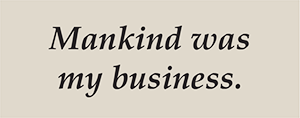
What this has to do with the American Shakespeare Center production of Greg Oliver Bodine's one-actor adaptation of Charles Dickens' A Christmas Carol is a line that stood out in Angela Iannone's performance: "Mankind was my business." Marley's Ghost roars this in reply to Scrooge contending Marley was always a good man of business. "The common welfare was my business," the Ghost continues: "charity, mercy, forbearance, benevolence were all my business. The dealings of my trade were but a drop of water in the comprehensive ocean of my business!"
I'm thankful we still have Dickens and a long line of artists, including William Shakespeare, telling us such truths in theaters around the world, especially in the world as it is on this Thanksgiving Day 2025, in which too many drops in the ocean of mankind have so little to be thankful for. "If all the year were playing holidays, to sport would be as tedious as to work," Prince Hal says in Shakespeare's Henry IV, Part One. You know, that would be true even of Christmas, my favorite time of year. But Thanksgiving Day every day, I could get into that. In fact, I sort of do, not with feasts and football and family and friends but by myself with my daily prayer of thanksgiving—prayer, meditation, thought, or however I wish to frame the words.
These days, I'm most thankful for all of you who have made mankind your business. There's a lot of business to attend to. — Eric Minton
© 2011–2025 Eric Minton
All Rights Reserved
Shakespeare Canon Project: 42 Plays, 42 Theaters, One Year
©2018-2019 Eric Minton, All Rights Reserved
On Stage On Screen On Air In Print Commentaries Dialogues Shakespearecure
Bard on the Boards Theater Links Web Links Shakespeare News Productions Seen Shakespeareances.com Top 40
Home Updates About Standards & Etiquette Sponsorships Terms & Conditions Contact
